
Timber Fencing Installation, Replacement and Repairs
Garden fencing has several jobs to perform. It defines where one property ends and another begins, provides privacy, helps protect children and pets, and influences how the entire garden looks. The right fence can create a calm, enclosed outdoor space; the wrong one may feel overpowering, offer insufficient privacy or struggle during the first spell of severe weather.
Merseyside Fencing installs and repairs garden fencing throughout Liverpool and the surrounding areas. We work with a wide selection of timber fencing styles, from economical lap panels and traditional feather-edge boards to contemporary slatted screens, decorative trellis and made-to-measure garden gates.
Rather than recommending the same product for every garden, we consider how the boundary will be used. Height, exposure, ground conditions, neighbouring properties, maintenance and appearance all matter. A fence that suits a sheltered courtyard may not be appropriate for an open garden exposed to strong winds.

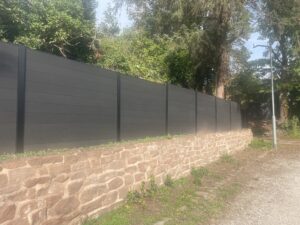
Case Study: Graphite Composite Fencing on a Sandstone Wall in Liverpool
A sandstone wall can be an attractive boundary, but it does not always provide the privacy a customer wants. At this Liverpool property, the wall followed a long stretch of outdoor space with mature trees behind it. The customer wanted to add height and screening while keeping the character of the existing stonework.
We installed graphite composite fencing above the sandstone wall, supported by black steel posts concreted into the ground. The dark fencing creates a strong contrast with the warm colour of the sandstone, giving the boundary a modern finish without covering up the wall.
Planning the New Boundary
The existing wall was an important part of the setting, so the new fence needed to follow its line neatly. Before installation, we assessed the route, checked the available ground beside the wall and planned the position of each post. Careful spacing was essential: the posts needed to support the composite sections while giving the finished fence a consistent appearance along the full length.
The wall also changes height as it runs towards the far end of the site. Rather than treating each section in isolation, we planned how the top of the fencing would look from the path. This helped the completed boundary appear continuous and balanced, even where the ground and stonework varied.
Installing the Steel Posts
The black steel posts provide the structure for the new fencing. We positioned them along the boundary, checked their alignment and concreted them securely into the ground. Setting the posts carefully was especially important on a long run: a small change in position at one point can become much more noticeable further along the fence.
We also checked the height and spacing as work progressed. This allowed the composite boards to sit neatly between the posts and kept the fence in line with the sandstone wall below. The dark posts work with the graphite boards, giving the installation a consistent finish.
Fitting the Graphite Composite Boards
Once the posts were secure, we fitted the graphite composite boards between them. The boards form a solid screen above the wall, adding privacy while leaving the sandstone visible from the path.
The colour choice makes a noticeable difference. Graphite sits comfortably against the mature greenery behind the boundary, while the lighter stone remains a feature in its own right. From a distance, the fence reads as one clean line; up close, the separate boards give it texture and detail.
We took care to keep the sections level and evenly spaced, checking the appearance from along the path as well as directly in front of the fence. That final visual check matters on a boundary of this length, where the overall line is just as important as the finish of each section.
The Finished Result
The completed installation gives this Liverpool boundary the extra height and screening the customer wanted. The composite fencing provides a more private feel, while the concreted steel posts give the panels a firm supporting structure.
The project also shows how a new fence can work with an existing feature. The sandstone wall still defines the site and retains its natural appearance; the graphite fencing adds a clean, contemporary layer above it. Together, they create a boundary that feels more substantial and looks well suited to its surroundings.
For the customer, the result is a practical improvement as well as a visual one: a long, tidy fence line, greater screening from the neighbouring space and a finish that complements both the stone wall and the trees behind it.
Choosing the Right Timber Garden Fence
Before choosing a design, it helps to decide what the new fence needs to accomplish. Some homeowners want maximum privacy, while others prefer a more open boundary that allows light and air to pass through. Families may need a secure enclosure, whereas keen gardeners might want fencing that supports climbing plants.
Important considerations include:
- The level of privacy required
- Whether the boundary is sheltered or exposed
- The height and length of the fence
- Changes in ground level
- Access for installation and future maintenance
- The presence of children or pets
- The appearance of the house and garden
- The condition of existing posts or foundations
- Whether panels may need replacing individually
- The available budget
We can explain the differences between the various styles and recommend an arrangement suited to the property.
Lap and Waney-Edge Fence Panels
Lap panels, also known as waney-edge or overlap panels, are one of the most recognisable forms of British garden fencing. Horizontal timber boards overlap one another and are held within a timber frame.
This is generally an economical option for straightforward garden boundaries. Lap panels provide privacy and are available in several standard heights. Individual panels can usually be replaced without rebuilding the entire fence.
Their strength depends on the quality of the frame, boards and installation. In an exposed position, a stronger panel or closeboard system may be preferable. Raising the panel above the soil with a gravel board can help protect the bottom edge from constant dampness.
Closeboard and Feather-Edge Fencing
Closeboard fencing is built using vertical feather-edge boards fixed onto horizontal timber rails. Each board overlaps the next, creating a solid and traditional-looking boundary.
Unlike standard panels, closeboard fencing can be constructed along the fence line. This makes it particularly useful for:
- Sloping or uneven gardens
- Boundaries with non-standard measurements
- Long fence runs
- Areas where additional strength is needed
- Customers wanting a continuous timber finish
Feather-edge boards are tapered, allowing them to overlap neatly. Because the system is assembled using separate components, damaged boards can often be replaced individually. Closeboard fencing works well with either timber posts or concrete posts and gravel boards.
Tongue-and-Groove Fencing
Tongue-and-groove fencing has interlocking boards that create a solid, smooth surface. It offers excellent privacy and usually has a more substantial appearance than basic overlap panels.
The boards fit closely together, helping to reduce gaps and create a smart finish on both traditional and contemporary properties. Framed tongue-and-groove panels are popular around patios, seating areas and gardens where appearance is especially important.
This type of fencing is heavier than a standard lap panel, so it requires correctly spaced, securely installed posts. Strong supporting posts are particularly important in exposed parts of Liverpool.
Shiplap Fencing
Shiplap boards have shaped edges that overlap and fit together. They are frequently used for sheds and garden buildings but can also be used to create solid fencing and gates.
Shiplap provides a tidy, uniform appearance and good screening. The overlapping profile helps manage rainwater while limiting visible gaps. It can be fitted horizontally for a traditional boarded effect or incorporated into framed sections.
Board-on-Board Fencing
Board-on-board fencing uses two layers of vertical boards. The second layer covers the gaps between the first, providing increased privacy while giving the boundary a deep, robust appearance.
This style is useful when privacy is the priority. It also remains visually interesting because of the alternating boards and natural shadows. More timber is required than for a single-layer fence, making it a more substantial option in both weight and cost.
Hit-and-Miss Fencing
Hit-and-miss fencing uses alternating boards on opposite sides of the rails. It provides a degree of privacy while allowing air to pass through the structure.
Because wind can move through the small spaces between the boards, hit-and-miss fencing may be considered for more exposed gardens. It can be constructed with vertical or horizontal boards and looks attractive from both sides, which is helpful on shared boundaries.
Although it provides screening when viewed straight on, it is not as completely private as closeboard or tongue-and-groove fencing.
Venetian and Slatted Timber Fencing
Venetian fencing consists of narrow horizontal timber slats separated by carefully controlled gaps. It is a popular contemporary option for landscaped gardens, modern extensions, patios and outdoor entertaining areas.
The horizontal lines can make a smaller garden appear wider. The gaps allow light and air through while still creating useful screening. The amount of privacy depends on the spacing and angle of the slats.
Slatted fencing requires accurate installation to keep every line straight and evenly spaced. It can be installed along an entire boundary or used as a decorative feature around a seating area.
Picket and Palisade Fencing
Timber picket fencing uses evenly spaced vertical boards with gaps between them. The tops can be rounded, pointed or shaped, depending on the preferred style.
Because it is lower and more open than a privacy fence, picket fencing is well suited to:
- Front gardens
- Paths and driveways
- Cottage-style properties
- Separating different garden areas
- Creating a boundary without blocking light
- Enclosing areas where full screening is unnecessary
Picket fencing creates a friendly, decorative boundary while still clearly defining the space.
Post-and-Rail and Ranch-Style Fencing
Post-and-rail fencing consists of horizontal rails secured between timber posts. It is commonly associated with larger gardens, rural properties and paddocks, but it can also provide an attractive open boundary in spacious residential settings.
Ranch-style fencing is similar, typically using broad horizontal boards. If a more secure enclosure is needed, wire mesh can sometimes be added discreetly to prevent pets from passing through the open sections.
Trellis and Lattice Fencing
Trellis is formed from narrow timber strips arranged in square, rectangular or diamond patterns. It can be used as a complete decorative screen or fitted above solid fencing.
A trellis top can add height without making the boundary feel completely enclosed. It also provides support for climbing roses, clematis, jasmine and other plants.
Common choices include:
- Square trellis
- Diamond lattice
- Privacy trellis with smaller openings
- Arched trellis panels
- Convex and concave decorative tops
- Slatted screening panels
Before increasing the height of a boundary with trellis, homeowners should check the applicable planning rules.
Decorative Framed Fence Panels
Decorative timber panels are available in a variety of framed designs. These can combine solid boarding, horizontal slats, lattice sections, curved tops and patterned inserts.
They are often chosen for prominent parts of a garden where the fence forms part of the overall landscaping. A framed panel generally provides a more finished appearance than a basic utility panel, although its weight means the posts and fixings must be suitable.
Willow, Hazel and Chestnut Fencing
Natural woven willow and hazel hurdles create a softer, rustic appearance. They are particularly effective in cottage gardens, wildlife-friendly spaces and areas where conventional panels might appear too formal.
Chestnut paling fencing consists of vertical chestnut pales connected with wire. It is commonly used for informal boundaries, woodland-style gardens, allotments and areas requiring a natural-looking enclosure.
These materials create character, but their expected lifespan, strength and maintenance requirements differ from pressure-treated timber panels.
Acoustic Timber Fencing
Acoustic fencing is designed to reduce the passage of sound. It uses solid, closely fitted timber boards and a construction method intended to minimise gaps.
No garden fence can remove every noise, but a correctly specified acoustic barrier may help reduce disturbance from traffic, neighbouring activity or nearby commercial premises. Its effectiveness depends on the fence’s height, density, position and continuity.
Because acoustic panels can be heavy, they require a suitably engineered supporting structure.
Concrete or Timber Posts?
Timber fencing can be supported by timber or concrete posts. Timber posts create a consistent natural appearance and are often preferred for decorative fencing. Pressure treatment and correct installation are important because the section close to ground level is most exposed to moisture.
Concrete posts do not rot and allow standard panels to be removed and replaced more easily. Concrete gravel boards can separate wooden panels from wet soil and may help retain small differences in ground level.
The most appropriate choice depends on appearance, budget, exposure, access and the style of fencing being installed.
Timber Fence Repairs in Liverpool
Storm damage does not always mean the entire boundary needs replacing. If most of the fence remains sound, it may be possible to replace individual panels, posts, boards or rails.
Typical fencing repairs include:
- Replacing storm-damaged panels
- Securing loose or leaning posts
- Replacing rotten feather-edge boards
- Renewing broken rails
- Replacing damaged gravel boards
- Realigning sections of fencing
- Repairing dropped or sticking gates
- Replacing hinges, catches and gate fittings
We assess the remaining structure before recommending a repair. Where widespread deterioration makes repeated repairs poor value, we will explain the available replacement options.
Timber Garden Gates
A gate should match the strength and purpose of the surrounding fence. Available styles include boarded gates, tongue-and-groove gates, ledged-and-braced gates, picket gates and contemporary slatted gates.
Correctly positioned hinges, strong supporting posts and suitable latches help prevent gates from dropping or becoming difficult to close. The opening width should also allow practical access for bins, bicycles, lawnmowers and garden equipment.
Garden Fencing Across Liverpool
Merseyside Fencing supplies and installs timber garden fencing across Liverpool and nearby areas. Whether you require economical replacement panels, strong closeboard fencing, a modern slatted screen or a new garden gate, we can help you compare the available options.
Contact us to arrange a quotation for garden fencing in Liverpool. Providing the approximate boundary length, desired height, preferred style and a few photographs can help us understand the project and advise on the most suitable next step.