
Feather board Fencing in Liverpool, Wirral & Merseyside
Feather board fencing is one of the most practical and versatile choices for creating a strong, private and attractive garden boundary. It is particularly well suited to properties where the fence line needs to follow changing ground levels, irregular boundaries or longer garden runs.
Merseyside Fencing supplies and installs featherboard fencing throughout Liverpool, Wirral and the wider Merseyside area, using carefully fitted featheredge boards, secure posts and robust horizontal rails to create a continuous boundary built around the individual property.
Unlike standard pre-made fence panels, featherboard fencing is constructed on site. This allows the fence to be tailored to the exact length, height and layout of the boundary rather than relying on fixed panel sizes.
Whether you are replacing an ageing fence, creating more privacy or installing fencing around a newly landscaped garden, feather board fencing can provide a neat and durable solution.
Contact Merseyside Fencing for a free, no-obligation feather board fencing quotation.
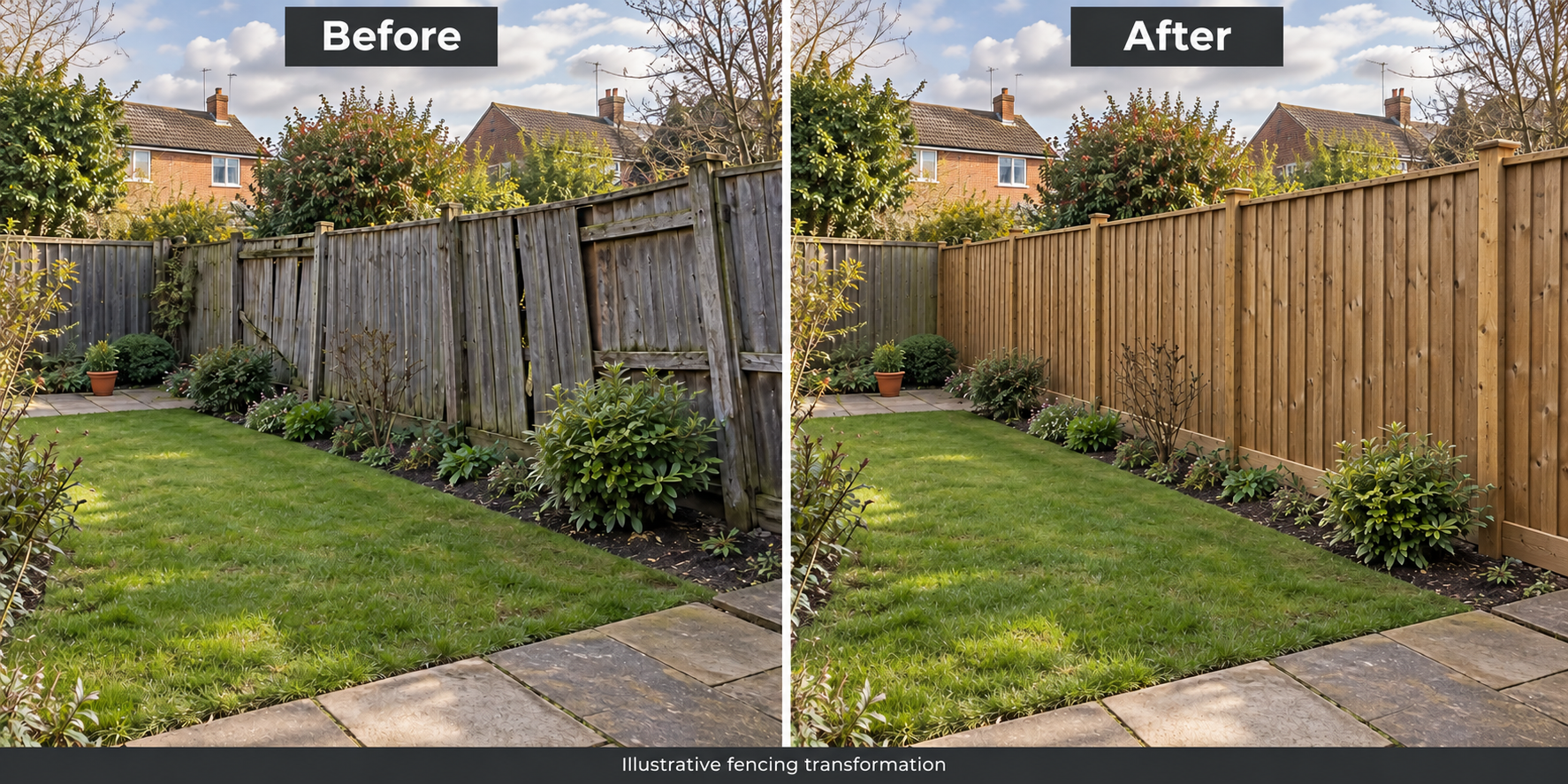
Traditional Feather-Edge Fence Replacement in Heswall
For this Heswall project, we replaced an existing garden fence with traditional feather-edge timber fencing. The new boundary measured 1800mm high, with 1829mm-wide sections between matching timber posts, finished with timber gravel boards.
The specification created a coordinated timber appearance, bringing the posts, boarding and base together into one consistent fence line.
Overlapping Boards for a Private Boundary
Feather-edge fencing uses tapered vertical boards that overlap to form a continuous screen. This makes it a practical choice where customers want privacy alongside a traditional garden finish.
On this installation, the overlapping boards created a clearly defined boundary while the matching timber posts complemented the fencing. Consistent section widths helped give the completed run a balanced appearance.
At 1800mm high, the new fence provided substantial screening without changing the character of the traditional timber design.
Timber Gravel Boards Along the Base
Timber gravel boards completed the bottom of the fence, separating the feather-edge boarding from direct contact with the ground. They also provided a neat base along the boundary.
Although timber gravel boards remain exposed to outdoor conditions, using them beneath the main boarding means the lower component can be assessed and replaced separately if it deteriorates over time.
A Coordinated Finish
The completed replacement gave this Heswall garden a fresh, clearly defined boundary. Its appeal came from a straightforward specification: overlapping feather-edge boards, matching timber posts and a continuous timber base.
This project illustrates how traditional feather-edge fencing can suit a garden without requiring decorative panels or contrasting materials. Careful planning of the height, section widths and supporting components helps produce a practical fence with a consistent finish.
We install and replace feather-edge fencing across Heswall and the wider Wirral, with specifications tailored to the property, ground conditions and customer’s preferred appearance.
What Is Feather board Fencing?
Featherboard fencing, sometimes referred to as featheredge fencing or closeboard fencing, is constructed using individual vertical timber boards.
Each board is slightly tapered, allowing the boards to overlap one another. The boards are fixed to horizontal rails that run between the main fence posts, creating a solid and continuous fence line.
A typical featherboard fence may include:
- Timber or concrete fence posts
- Horizontal timber rails
- Overlapping featheredge boards
- Timber or concrete gravel boards
- Capping or finishing rails where required
- Matching garden gates where appropriate
Because the fence is assembled piece by piece, it can be adapted to suit a wide range of gardens and property boundaries.
Why Choose Featherboard Fencing?
There are several reasons featherboard fencing remains a popular choice for residential gardens.
One of the biggest advantages is strength. The overlapping boards are individually fixed to the rails, creating a continuous structure rather than relying on a single pre-manufactured panel.
It is also highly adaptable.
Featherboard fencing works particularly well where:
- The garden slopes
- The boundary is not perfectly straight
- Standard panel sizes would leave awkward gaps
- Additional privacy is required
- A long run of fencing needs a consistent appearance
- Existing concrete posts are being reused where suitable
- A gate needs to be incorporated into the fence line
The finished result can provide a traditional appearance while still working well with modern gardens, patios and landscaping.
Featherboard Fencing for Privacy
Privacy is often one of the main reasons homeowners decide to replace their fencing.
An older boundary may have become too low, developed gaps or started leaning. In other cases, a new patio, seating area or garden room may mean that additional privacy is now important.
Because featheredge boards overlap, featherboard fencing creates a relatively solid visual barrier.
This makes it suitable for:
- Rear gardens
- Side boundaries
- Patio and seating areas
- Family gardens
- Properties close to neighbouring homes
- Gardens backing onto paths or roads
The required fence height should always be considered carefully, particularly where planning restrictions or boundary rules may apply.
Timber Posts or Concrete Posts?
Featherboard fencing can be installed with either timber or concrete posts.
Both systems can work well, and the most suitable choice will depend on the property, budget and preferred appearance.
Timber Posts
Timber posts create a traditional all-timber fence and can blend naturally into landscaped gardens.
They are often chosen where:
- A softer appearance is preferred
- The fence is being installed alongside timber gates
- The existing boundary already uses timber posts
- Cost is an important consideration
Correct installation and suitable timber treatment are important because timber posts are exposed to moisture where they enter the ground.
Concrete Posts
Concrete posts are a popular choice for customers looking for a more durable support system.
Benefits can include:
- Resistance to rot at ground level
- Good strength in exposed locations
- Long service life
- Compatibility with concrete gravel boards
- Reduced need to replace posts as frequently
The timber boards and rails still provide the natural appearance of a wooden fence, while the concrete posts form the main supporting structure.
The Importance of Gravel Boards
Gravel boards are installed at the bottom of the fence between the posts.
They help separate the timber fencing from direct contact with soil, moisture and garden debris.
This can be particularly useful where lawns, flower beds or soil sit directly against the boundary.
Featherboard fencing can be installed with either:
- Timber gravel boards
- Concrete gravel boards
Concrete gravel boards are especially popular when used alongside concrete posts because they provide a robust lower section and help protect the timber above.
Featherboard Fencing on Sloping Gardens
One of the main advantages of featherboard fencing is its ability to adapt to changing ground levels.
Standard fence panels are manufactured in fixed rectangular sizes. On a sloping garden, this can sometimes lead to large steps between panels or uneven gaps at ground level.
Featherboard fencing can be constructed to follow the boundary more naturally.
Depending on the site, the fence may:
- Step gradually with the ground
- Follow the slope more closely
- Use adjusted board lengths
- Incorporate stepped gravel boards
- Be designed around walls, paths or landscaping
This flexibility can make featherboard fencing particularly useful for gardens where the boundary is not completely level.
Replacing Old Featherboard Fencing
Older featherboard fences can deteriorate in different ways.
Sometimes the vertical boards remain reasonable while the posts or rails have weakened. In other cases, several components may have reached the end of their useful life.
Common signs that replacement may be required include:
- Fence posts leaning
- Rotten timber at ground level
- Broken horizontal rails
- Loose featheredge boards
- Large sections moving in strong winds
- Repeated repairs becoming necessary
- Gravel boards deteriorating
- The entire fence losing alignment
Where only a small section is damaged, repair may be possible. However, if several posts and rails are failing, replacement can often provide a more reliable long-term result.
Featherboard Fence Repairs
Not every featherboard fence needs to be replaced completely.
Because it is constructed from individual components, certain parts can sometimes be repaired independently.
Possible repairs include:
- Replacing damaged featheredge boards
- Renewing broken rails
- Replacing failed timber posts
- Repairing loose sections
- Replacing damaged gravel boards
- Strengthening individual sections
- Repairing fencing following storm damage
Before carrying out repairs, it is important to consider the condition of the surrounding structure.
There is little value in replacing a few boards if the supporting posts and rails are already badly deteriorated.
A Good Choice for Long Garden Boundaries
Featherboard fencing works particularly well for longer boundaries.
Because it is built continuously, it creates a consistent appearance along the full length of the garden.
This can be useful for:
- Corner properties
- Large rear gardens
- Side boundaries
- Properties adjoining open land
- Commercial premises
- Long driveway boundaries
The continuous construction can also reduce the visual interruption created by repeated panel frames.
For many customers, this gives featherboard fencing a cleaner and more substantial appearance.
Adding a Garden Gate
A new fence often requires a matching gate for access.
Timber garden gates can be installed within a featherboard fencing system so that the gate complements the surrounding boundary.
Depending on the property, the gate may be used for:
- Side access
- Rear garden access
- Bin access
- Driveway entrances
- Utility areas
- Secure garden access
The supporting gate posts need to be strong enough to carry the weight of the gate and resist movement during regular use.
A correctly installed gate should open smoothly, close properly and align neatly with the surrounding fencing.
Featherboard Fencing and Garden Landscaping
New fencing is often part of a wider garden improvement project.
A fresh featherboard fence can create a clean backdrop for patios, artificial grass, decking, planting and other landscaping.
Because timber has a natural appearance, it works well with a wide range of garden styles.
It can complement:
- Porcelain patios
- Indian sandstone paving
- Artificial lawns
- Composite decking
- Raised beds
- Garden rooms
- Outdoor seating areas
- Traditional planting
If your garden is being completely redesigned, it often makes sense to consider the fencing early in the project.
A sound boundary can provide a better starting point for the rest of the landscaping.
Featherboard Fencing Across Liverpool, Wirral and Merseyside
Merseyside Fencing installs and repairs featherboard fencing throughout Liverpool, Wirral, Knowsley, Sefton, St Helens and surrounding parts of Merseyside.
We work on a variety of residential properties, from small urban gardens to larger suburban boundaries.
Our featherboard fencing service can cover anything from a short replacement section to a complete garden perimeter.
Where appropriate, we can discuss different combinations of timber boards, posts and gravel boards so that the finished fencing suits both the garden and the customer’s requirements.
Planning a New Featherboard Fence
Before installing a new fence, there are several practical points worth considering.
These include:
- The condition of the existing boundary
- Fence height
- Ground levels
- Access to the garden
- Existing walls or paving
- Drainage around the boundary
- Whether old fencing needs removing
- The location of gates
- The preferred post type
- Whether gravel boards are required
- Neighbouring boundaries
- Underground services where relevant
Considering these details before installation helps reduce surprises during the work.
Why Use Merseyside Fencing?
A featherboard fence is only as good as the structure supporting it.
Good installation requires more than simply fixing boards to rails. Posts need to be positioned securely, fence lines need to be aligned carefully and boards should be fixed consistently.
Merseyside Fencing provides professional fencing services with an emphasis on practical installation and a tidy finished result.
Customers choose featherboard fencing because it offers a useful balance of:
- Privacy
- Strength
- Traditional appearance
- Flexibility
- Repairability
- Compatibility with timber or concrete posts
We can discuss the available options and provide a clear quotation before work begins.
Featherboard Fencing Costs: Choosing the Right Specification
Featherboard fencing built on site is quoted to suit your boundary. The cost depends on the length and height of the fence, the supporting posts, gravel boards and the work needed to prepare the existing fence line.
We assess:
-
Fence dimensions: the overall length, required height and changes in ground level.
-
Posts and supports: timber or concrete posts, horizontal rails and suitable fixings.
-
Gravel boards: timber or concrete, according to your preferred finish and site conditions.
-
Removal work: taking down old fencing and dealing with existing posts or concrete foundations.
-
Access and extras: narrow passages, obstacles, matching gates and finishing details.
Your quotation will confirm the materials, installation work and agreed disposal arrangements. Our guide price for ready-made panel fencing does not automatically apply to featherboard fencing constructed board by board.
For an initial discussion, send your postcode, approximate boundary length and photographs showing the existing fence and garden access.
Frequently Asked Questions About Featherboard Fencing
1. How much does a new featherboard fence cost?
We quote each installation individually. A straight boundary with easy access requires different work from a sloping fence line with old foundations to remove. Height, post type, gravel boards and gates also affect the total. We confirm the specification and fitted price before work begins.
2. Should I choose timber or concrete posts?
Timber posts create a coordinated all-timber appearance, while concrete posts avoid timber rot in the supporting posts. Both can be suitable when correctly specified and installed. We discuss ground conditions, appearance and budget before recommending an arrangement.
3. How long does installation take?
The timescale depends on the length of the fence and the preparation required. Removing old posts, working around planting or paving, changes in level and fitting gates can add time. We provide an estimated schedule after assessing the boundary rather than applying a panel-fitting timescale to every featherboard installation.
4. Will you remove and dispose of the old fence?
We can include removal and disposal of the fencing being replaced. Your quotation will identify the agreed work, including whether old posts, gravel boards and concrete foundations need removing. Please mention additional waste or vegetation clearance beforehand so these can be assessed separately.
5. Can featherboard fencing be repaired or fitted with a matching gate?
Yes. Where posts and rails remain sound, damaged feather-edge boards can often be replaced individually. More extensive deterioration may require a larger section to be renewed. We can also incorporate a bespoke timber gate with complementary boarding, suitable supporting posts and your preferred latch or locking arrangement.
Get a Free Featherboard Fencing Quote
If you are considering new featherboard fencing, replacement fencing or repairs to an existing featheredge fence, contact Merseyside Fencing.
We provide fencing services across Liverpool, Wirral and the wider Merseyside region.
Whether you need a small section replacing or a complete new garden boundary, we can assess the work and recommend a suitable approach.
Call Merseyside Fencing on 0151 271 7414
Email: info@merseysidefencing.uk
Or use our online enquiry form to request a free, no-obligation featherboard fencing quotation.