
Panel Fencing Installation in Wirral & Merseyside
Panel fencing remains one of the most popular ways to create a practical, private and tidy garden boundary. It is adaptable, straightforward to maintain and can be combined with concrete posts and gravel boards to create a fencing system designed for long-term outdoor use.
Merseyside Fencing installs and replaces panel fencing throughout Liverpool, Wirral and the wider Merseyside area, from single damaged panels to complete garden boundaries.
A panel fence can be kept simple with traditional timber panels and timber posts, or upgraded with concrete posts and concrete gravel boards for a more substantial installation. Customers can also choose different finishes for the concrete base boards, including plain concrete gravel boards and decorative rock-face styles.
The right combination depends on the appearance you want, the condition of the boundary, ground levels and how much maintenance you would prefer in the future.
If you are considering new panel fencing, Merseyside Fencing can provide a free, no-obligation quotation.
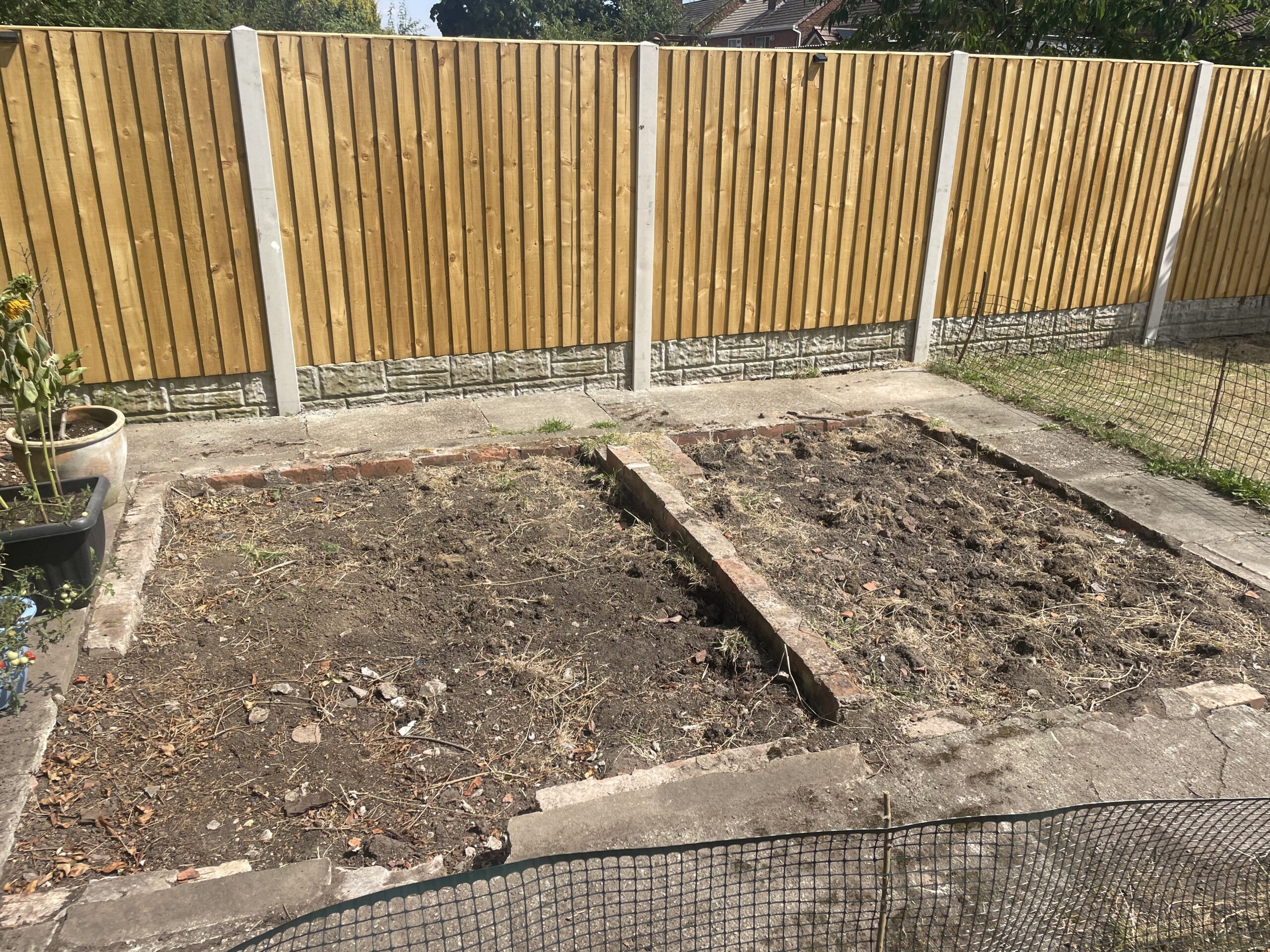
Eastham Fence Panel Replacement: Keeping the Existing Posts and Gravel Boards
This fencing job in Eastham demonstrates one of the main advantages of installing timber panels with slotted concrete posts and concrete gravel boards: when the timber panels need replacing, the whole fence does not necessarily need rebuilding.
The existing concrete posts and gravel boards had been installed over 12 years ago. They remained suitable for reuse, allowing us to retain the framework and replace only the old timber panels.
Each replacement panel measured 1500mm high × 1829mm wide. Positioned above the existing 300mm concrete gravel board, this maintained an overall fence height of 1800mm.
We slid the old panels out of the channels in the concrete posts and fitted the new panels into the same slots. With no need to replace the posts or gravel boards, the work involved less disruption than a complete fence replacement.
The new timber panels refreshed the appearance of the boundary while making continued use of the durable concrete components already in place.
A Practical Advantage for Future Maintenance
This Eastham project shows why a panel fencing system can be a worthwhile long-term choice. Timber panels can deteriorate over time, while sound concrete posts and gravel boards may remain serviceable through more than one set of panels.
Replacement is straightforward where the existing posts are secure, the slots are accessible and the new panels fit correctly. We check these details before recommending panel-only replacement.
If your timber panels are looking tired but the concrete framework remains sound, replacing just the panels could be a practical alternative to rebuilding your entire fence.
Eastham Customer Review

What Is Panel Fencing?
Panel fencing uses pre-manufactured timber fence panels positioned between vertical posts.
Unlike fencing built board by board on site, panel fencing arrives in complete sections that are installed between posts.
A typical panel fencing installation can include:
- Timber fence panels
- Timber or concrete fence posts
- Timber or concrete gravel boards
- Post caps where appropriate
- Matching or complementary garden gates
- Suitable fixings and support components
This modular construction means individual sections can often be replaced later without rebuilding the whole fence.
That is one reason panel fencing remains particularly popular for domestic gardens.
Why Choose Panel Fencing?
Panel fencing provides a useful combination of privacy, appearance and practicality.
It can work well for:
- Rear garden boundaries
- Side boundaries
- Areas requiring greater privacy
- Replacing old or storm-damaged fencing
- Creating separation between neighbouring gardens
- New landscaping projects
- Rental properties
- Family gardens
- Properties requiring easy future panel replacement
Different panel designs are available, allowing homeowners to choose between relatively simple traditional fencing and more decorative options.
Panel Fencing with Concrete Posts
One of the most common upgrades to traditional timber fencing is the use of concrete fence posts.
The fence panel remains timber, but the structural posts are made from precast concrete.
This arrangement is popular because the area where a fence post enters the ground is often one of the most vulnerable parts of a traditional timber fence.
Concrete posts are not affected by timber rot and provide a strong framework for the fencing.
Advantages of concrete posts can include:
- Strong structural support
- Resistance to rot
- Long service life
- Suitable for replaceable panel systems
- Compatibility with concrete gravel boards
- A stable option for exposed garden boundaries
- Reduced reliance on timber below ground level
Concrete posts are particularly useful where an old fence has failed because the original timber posts have deteriorated.
Slotted Concrete Fence Posts
Many panel fencing systems use slotted concrete posts.
The timber fence panel fits into the channels running down each side of the post. A gravel board can then sit underneath the panel.
This creates a simple modular system.
If a timber panel becomes damaged later, it may be possible to remove the old panel and insert a replacement while retaining the existing concrete posts and gravel board, assuming those components remain structurally sound.
This can make future maintenance easier than fencing systems where every component is permanently fixed together.
What Are Gravel Boards?
A gravel board is positioned along the bottom of the fence underneath the timber panel.
You may also hear these referred to as:
- Kick boards
- Kicking boards
- Base boards
- Fence base boards
Their main purpose is to create a barrier between the timber fence panel and the ground.
Without a gravel board, the bottom of the timber panel may sit close to damp soil, grass, leaves and garden debris.
A gravel board raises the timber away from these conditions.
Why Use Gravel Boards?
Gravel boards perform both practical and visual roles.
They can help:
- Keep timber panels away from wet ground
- Protect the lower edge of fencing
- Create a neat finished base
- Deal with small variations in ground level
- Retain limited amounts of soil where suitable
- Make individual fence panels easier to replace
- Provide a stronger-looking lower section
They are particularly useful in gardens where planting beds, lawns or soil run directly alongside the fence line.
Concrete Gravel Boards
Concrete gravel boards are commonly paired with concrete posts.
They create a durable base underneath the timber panel and are available in several styles.
A concrete gravel board does not rot and can continue to support replacement fence panels long after an older timber panel has reached the end of its useful life.
This makes the concrete-post-and-gravel-board system a popular choice for homeowners who want timber fencing without relying on timber for the structural components closest to the ground.
Plain Concrete Gravel Boards
Plain concrete gravel boards provide a simple, understated appearance.
They are usually chosen where the customer wants the base of the fence to look neat without becoming a major visual feature.
Plain boards work particularly well with:
- Traditional timber panels
- Modern gardens
- Patios
- Artificial grass
- Simple landscaped spaces
- Long straight boundaries
For many properties, plain gravel boards are the most practical choice because they allow the timber fencing to remain the main visual feature.
Rock-Face Gravel Boards
For homeowners who prefer a more decorative finish, rock-face concrete gravel boards can provide additional texture.
Rather than having a completely smooth or plain surface, the visible face is moulded to create a stone-like appearance.
Rock-face gravel boards can work particularly well alongside:
- Traditional properties
- Stone paving
- Decorative garden walls
- Landscaped borders
- Established planting
- Rustic garden designs
They provide the same basic function as plain gravel boards but create a more decorative base beneath the fencing.
The choice between rock-face and plain boards is largely an aesthetic one.
Plain or Rock Face – Which Should You Choose?
There is no universally better finish. It depends on the garden and the appearance you want.
Plain concrete gravel boards may suit you if:
- You prefer a clean, simple appearance
- The fencing itself should be the main feature
- Your garden has a modern design
- You want an understated concrete base
Rock-face gravel boards may suit you if:
- You like a more decorative appearance
- Your garden contains stone or textured materials
- You want the gravel boards to contribute to the design
- You prefer a more traditional finish
Both options can provide the same important separation between the timber panel and the ground.
Timber Gravel Boards
Concrete is not the only option.
Panel fencing can also be installed with timber gravel boards.
These may be preferred where the customer wants an all-timber appearance or is installing a more economical fencing system.
Timber boards blend naturally with timber posts and panels, although they remain an exterior timber product and will generally require more consideration for moisture exposure than concrete.
The appropriate option will depend on the fencing specification and customer’s priorities.
Choosing the Right Fence Panels
There are many different styles of timber fence panel.
Some focus mainly on privacy, while others provide a more decorative appearance.
Common panel styles may include:
- Traditional lap panels
- Closeboard-style panels
- Vertical boarded panels
- Decorative panels
- Trellis-topped panels
- Pressure-treated timber panels
The right panel depends on:
- The desired level of privacy
- Fence height
- Garden style
- Budget
- Exposure to wind
- Surrounding landscaping
- Existing fencing
For more exposed gardens, strength and structural support are particularly important.
Replacing Old Fence Panels
One advantage of a concrete-post panel system is that damaged timber panels can often be replaced separately.
A panel may need replacement because of:
- Storm damage
- Split timber
- Rot
- Impact damage
- General age
- Repeated movement in strong winds
If the concrete posts and gravel boards are still in good condition, replacing only the damaged panel can be much more straightforward than rebuilding the complete fence.
We can inspect the surrounding components before recommending whether individual replacement is worthwhile.
When More Than the Panel Is Damaged
Sometimes a broken panel is only the most visible sign of a larger problem.
Before replacing it, it is worth checking:
- Are the posts vertical and secure?
- Are any concrete posts cracked?
- Have gravel boards moved?
- Is the ground around the posts unstable?
- Are neighbouring panels also deteriorating?
- Has the boundary started leaning?
-
Is wind repeatedly damaging the same area?
If structural components have failed, simply inserting a new panel may not solve the underlying problem.
Panel Fencing for Sloping Gardens
Panel fencing can be installed on gardens with changing ground levels, although careful planning is needed because the panels themselves are rectangular.
The fence may need to be stepped as the ground rises or falls.
This can involve:
- Stepping fence panels gradually
- Adjusting gravel-board levels
- Selecting suitable panel heights
- Working around retaining walls
- Considering gaps beneath stepped sections
For strongly sloping or irregular boundaries, featherboard fencing may occasionally offer greater flexibility, but panel fencing can still work effectively in many sloping gardens.
Fencing Height and Privacy
Panel fencing is frequently chosen because it creates a relatively quick and effective privacy boundary.
When planning the height, consider:
- Existing fence height
- Neighbouring ground levels
- Patios or raised areas
- Views into the garden
- Children and pets
- Local planning restrictions
- Visibility near roads or driveways
Higher is not automatically better. The fence should suit the garden while remaining appropriate for the location.
Panel Fencing and Garden Landscaping
New fencing can make a significant difference to the overall appearance of a garden.
A tired, leaning boundary can make even a newly landscaped garden feel unfinished.
Panel fencing with concrete posts and gravel boards can create a strong background for:
- Patios
- Artificial grass
- Natural lawns
- Decking
- Garden rooms
- Raised beds
- Outdoor furniture
- Planting areas
- Pathways
Choosing the fencing before completing major landscaping can also make installation easier by providing access before patios or planting are finished.
Panel Fencing Repairs
Not all panel fencing problems require complete replacement.
Depending on the condition of the fence, repairs can include:
- Replacing a single timber panel
- Replacing several damaged panels
- Renewing timber posts
- Replacing cracked gravel boards
- Replacing damaged concrete posts
- Correcting loose sections
- Repairing gates
- Restoring storm-damaged fencing
Where most of the existing system remains sound, targeted repairs can extend the useful life of the fence.
Panel Fencing Across Liverpool, Wirral and Merseyside
Merseyside Fencing provides panel fencing installation, replacement and repair services throughout Liverpool, Wirral and the wider Merseyside area.
We cover locations including:
- Liverpool
- Wirral
- Knowsley
- Sefton
- St Helens
- Heswall
- Greasby
- West Kirby
- Wallasey
- Birkenhead
- Crosby
- Surrounding Merseyside areas
Projects range from single damaged panels to complete garden boundaries using new timber panels, concrete posts and gravel boards.
Planning Your New Panel Fence
Before installing panel fencing, it is useful to consider:
- Overall boundary length
- Preferred panel style
- Required fence height
- Timber or concrete posts
- Plain or rock-face gravel boards
- Existing ground levels
- Whether old fencing requires removal
- Access to the garden
- Gate positions
- Nearby walls or paving
- Privacy requirements
- Condition of neighbouring fencing sections
You don’t need to have every detail decided before requesting a quotation. These options can be discussed after looking at the existing boundary.
Why Choose Merseyside Fencing?
A good panel fencing installation depends on much more than the panels themselves.
Posts need to be secure, gravel boards need to be properly positioned and the completed fence line should be straight, stable and appropriate for the garden.
Our panel fencing service can include:
- Complete new fencing installation
- Replacement timber panels
- Concrete post installation
- Plain concrete gravel boards
- Rock-face gravel boards
- Timber gravel boards
- Fence repairs
- Gate installation
- Removal of old fencing where agreed
- Free quotations
The aim is to provide a practical fencing system that suits the property rather than using the same specification for every garden.
Panel Fencing Prices and Frequently Asked Questions
New panel fencing starts from £125 per section, based on an 1800mm × 1800mm timber fence panel with concrete posts, including removal and disposal of the old fencing.
This is a rough guide, subject to a site survey. The final cost depends on the number of sections, access, ground conditions and your chosen specification. Your quotation will confirm whether gravel boards are included and any additional cost for plain or decorative concrete boards. Gates and other bespoke work are quoted separately.
1. How long does panel fencing installation take?
As a guide, installation takes approximately one hour per section for a straightforward replacement. Removing old posts, difficult ground, restricted access and changes in level can increase the time required. We will give you an estimated timescale when quoting.
2. Can you replace just the timber panels?
Yes. If the existing posts and gravel boards remain secure, correctly spaced and in good condition, we can often replace the timber panels without rebuilding the whole boundary. Panel-only replacement is quoted separately from our guide price for a new installation.
3. Is removal and disposal of the old fence included?
Our guide price includes removal and disposal of the old fencing being replaced. Please mention any additional rubbish, overgrown vegetation or other structures when requesting a quote so we can confirm the full scope and cost beforehand.
4. Why choose concrete posts rather than timber posts?
Concrete posts do not suffer from timber rot and provide a durable framework for panel fencing. Slotted posts can also make future panel replacement easier, provided the posts remain sound. Timber posts are another option if you prefer an all-timber appearance.
5. Can panel fencing be fitted on a sloping garden?
Yes. Panels can often be stepped along the boundary to follow changes in ground level. We assess the slope, gravel-board arrangement and any gaps beneath the fence before recommending a layout. On particularly uneven boundaries, fencing built board by board may offer greater flexibility.
Get a Free Panel Fencing Quote
If you are considering new panel fencing, concrete posts, gravel boards or replacement fence panels, contact Merseyside Fencing.
We install and repair panel fencing throughout Liverpool, Wirral and the wider Merseyside region.
Whether you need one damaged section replacing or an entirely new garden boundary, we can assess the existing fencing and discuss the most suitable combination of panels, posts and gravel boards.
Call Merseyside Fencing on 0151 271 7414
Email: info@merseysidefencing.uk
Or use our online enquiry form to request a free, no-obligation panel fencing quotation.