
Timber Picket Fencing in Wirral & Merseyside
Picket fencing is a distinctive and practical choice for homeowners who want to define a boundary without making a garden feel enclosed. Its open design allows light through, maintains visibility and gives front gardens, paths and landscaped areas a neat, traditional finish.
Merseyside Fencing supplies and installs timber picket fencing throughout Liverpool, Wirral and the wider Merseyside area, including new installations, replacement sections, matching pedestrian gates and repairs to existing picket fences.
Unlike full-height privacy fencing, picket fencing is usually used where appearance, boundary definition and access control are more important than complete screening. It can work particularly well around front gardens, pathways, lawns, flower beds and lower-level boundaries.
Because picket fencing can be built in different heights, board shapes and spacing arrangements, it can be adapted to suit both traditional and more contemporary homes.
If you are considering a new picket fence, contact Merseyside Fencing for a free, no-obligation quotation.
Picket Fence at Life Bank Nursery in Liverpool
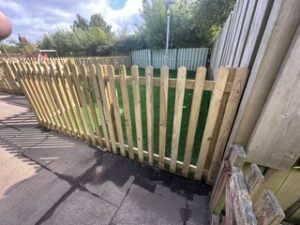
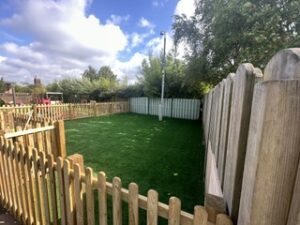
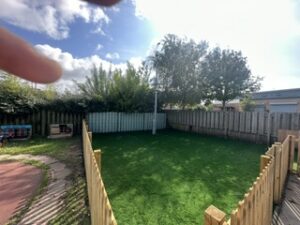
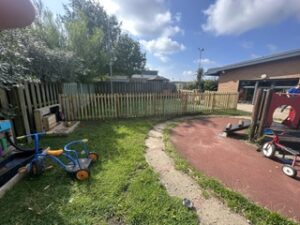
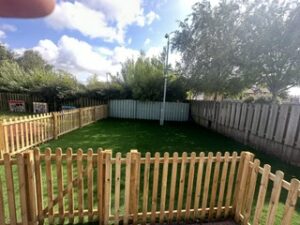
Case Study: Picket Fencing for Life Bank Nursery in Kensington, Liverpool
Life Bank Nursery in Kensington, Liverpool, needed a clearly defined boundary around its toddlers’ outdoor play area. The aim was to separate the playground from surrounding areas while maintaining an open, welcoming space where nursery staff could see through the fencing.
We installed approximately 30 linear metres of timber picket fencing, measuring 900mm high, together with a matching pedestrian gate.
An Open Boundary Around the Play Area
Picket fencing suited the nursery’s brief because it provided a physical boundary without creating a solid screen. The spaces between the timber pickets allowed visibility into and out of the playground, helping staff oversee the area while retaining its light, open appearance.
The fence followed the perimeter of the play space, creating a clear distinction between the toddlers’ activity area and the space beyond it. Consistent picket spacing and a neat fence line gave the installation a coordinated finish.
A Matching Gate for Everyday Access
The matching timber gate provided a designated entrance for staff and children. Incorporating the gate into the fencing layout meant access could be managed through one opening rather than leaving a permanent gap in the boundary.
The gate complemented the height and style of the surrounding picket fence, making it a practical part of the installation.
Supporting a Managed Nursery Playground
The completed fencing gave Life Bank Nursery a defined outdoor play area designed to help manage toddlers’ movement and access. Its low, open design provided separation while allowing staff to maintain visibility across the boundary.
The fence and gate support the nursery’s supervision arrangements; secure gate use, regular checks and active supervision remain essential.
This Kensington project demonstrates how timber picket fencing can provide a practical boundary for a nursery playground, combining clear separation, convenient access and an appearance suited to an outdoor play setting.
What Is Picket Fencing?
Picket fencing is normally constructed using vertical timber boards fixed to horizontal rails between supporting posts.
The vertical boards are known as pickets. Unlike featherboard fencing, they are deliberately spaced apart, creating an open boundary rather than a solid screen.
A typical timber picket fence may include:
- Timber fence posts
- Horizontal timber rails
- Individual vertical pickets
- Decorative picket tops
- Matching pedestrian gates
- Post caps where appropriate
- Timber treatment or decorative finish
The spacing between the boards can be adjusted depending on the appearance and level of enclosure required.
Why Choose Picket Fencing?
Picket fencing has a very different purpose from tall privacy fencing.
It is often selected because it defines a boundary while keeping the garden open and welcoming.
It can be particularly useful where you want to:
- Mark the edge of a front garden
- Separate a lawn from a path
- Create a decorative property boundary
- Keep children away from planting areas
- Create a low barrier for certain pets
- Border a cottage-style garden
- Protect flower beds
- Add a matching gate to a pathway
- Replace old or damaged low-level fencing
- Maintain visibility across the garden
For many properties, the main appeal is that a picket fence provides structure without creating the visual weight of a solid six-foot fence.
Picket Fencing for Front Gardens
Front gardens are one of the most common places to use picket fencing.
A full-height privacy fence may feel too imposing at the front of a property, particularly where there is a small lawn, driveway or path close to the pavement.
Picket fencing can define the property line while keeping the house and garden visible.
It can work well with:
- Traditional terraced houses
- Semi-detached properties
- Cottages
- Modern homes with landscaped front gardens
- Properties with paved pathways
- Lawns and planted borders
- Small entrance gardens
A matching picket gate can create a clear entrance without making the boundary feel overly restrictive.
Different Picket Top Styles
The shape of the top of each picket can change the overall character of the fence.
Common styles include:
Pointed Pickets
A classic shape with a defined point at the top.
This gives the fence a traditional appearance and works particularly well with older properties and cottage-style gardens.
Rounded Pickets
Rounded tops create a softer look.
They are often chosen where a less formal appearance is preferred or where the fence is being installed near family areas.
Flat-Top Pickets
Flat-top pickets have a simple, clean appearance.
They can work well with more modern landscaping and are easy to combine with contemporary gates and garden features.
Decorative or Shaped Pickets
Some designs use curved, chamfered or more decorative tops.
These can create a stronger visual feature where the fencing is intended to contribute to the overall garden design.
Choosing the Right Picket Fence Height
Picket fencing can be installed at different heights depending on its purpose.
A very low fence may simply divide a lawn from a path or planting area, while a taller picket fence may be used to define the main property boundary.
When choosing a height, consider:
- The size of the garden
- Whether the fence is decorative or functional
- The height of nearby walls and hedges
- Visibility from the pavement
- Children and pets
- The style of the house
- Existing boundary features
- Local planning restrictions where applicable
A fence that is too tall may lose the open character that makes picket fencing attractive, while one that is too low may not provide the separation required.
Picket Spacing
The gaps between pickets are another important design choice.
Wider spacing creates a lighter, more open appearance, while closer spacing provides a stronger sense of enclosure.
Spacing can affect:
- Visibility
- Light levels
- Overall appearance
- Suitability for children
- Suitability for pets
- Material quantity
- Wind resistance
Where picket fencing is intended to help contain a small pet, the gaps between boards should be considered carefully.
A decorative fence with wide gaps may look attractive but provide little practical containment.
Timber Posts for Picket Fencing
Picket fencing is commonly installed using timber posts because the timber supports naturally complement the boards and rails.
Correct post installation is essential.
Even a relatively low fence can begin leaning if the posts are poorly installed or have deteriorated at ground level.
The posts need to:
- Be spaced appropriately
- Remain vertical
- Support the horizontal rails securely
- Resist movement in wind
- Match the height and scale of the fence
Where an existing picket fence is being replaced, we can assess whether any existing posts are suitable for reuse or whether complete replacement is more appropriate.
Rails and Structural Support
The horizontal rails connect the fence posts and provide the fixing surface for the pickets.
Most picket fences use two horizontal rails, although the exact arrangement depends on the height and design.
The rails should be:
- Securely fixed
- Level or correctly stepped on sloping ground
- Strong enough to support the pickets
- Positioned consistently along the fence
Poorly supported rails can cause individual pickets to move or the whole fence section to lose alignment.
Picket Fencing on Sloping Ground
Picket fencing can work well on gently sloping gardens and paths.
Depending on the site, the fence can either step with the ground or be constructed so the top follows the slope more gradually.
Possible approaches include:
- Stepped fence sections
- Adjusted picket lengths
- Rails following the gradient
- Different post heights
The best method depends on the steepness of the slope and the appearance the customer prefers.
Because picket fencing is made from individual boards, it can often be adapted more easily than rigid pre-manufactured panels.
Matching Timber Picket Gates
A matching gate can complete the appearance of a picket fence.
Picket gates are commonly used at:
- Front paths
- Side entrances
- Garden walkways
- Lawn entrances
- Children’s play areas
- Decorative garden divisions
A matching gate can use the same picket profile, spacing and height as the surrounding fence.
Important installation details include:
- Strong gate posts
- Suitable hinges
- A reliable latch
- Correct clearance from the ground
- Proper alignment
- Appropriate opening direction
The gate should look like part of the fence while still being practical for everyday use.
Picket Fencing for Children and Pets
Picket fencing is sometimes used as a lower-level barrier in family gardens.
However, the fence design should be chosen according to its actual purpose.
For children, consider:
- Overall fence height
- Gate latch position
- Gap size
- Stability
- Sharp or pointed tops
For pets, consider:
- The size of the animal
- How easily it can jump
- Whether it can pass through the gaps
- Whether it is likely to dig underneath the fence
- Gate security
Picket fencing is not suitable for every containment situation, but with appropriate spacing and height it can provide useful separation in some gardens.
Painted or Natural Timber?
Picket fencing can be left with a natural timber appearance or finished with a suitable exterior coating.
Natural timber works well in many gardens and can weather gradually over time.
Painting or staining can create a stronger visual feature.
Popular approaches include:
- Natural timber
- White painted picket fencing
- Dark grey finishes
- Green garden paint
- Wood stains
- Clear or tinted exterior treatments
Any finish should be suitable for exterior timber and maintained according to the product manufacturer’s recommendations.
A painted picket fence may require more ongoing maintenance than a natural timber finish, but it can create a distinctive feature at the front of a property.
White Picket Fencing
White picket fencing has a particularly traditional appearance and is often associated with cottage gardens and decorative front boundaries.
It can look especially effective alongside:
- Brick pathways
- Flower borders
- Cottage planting
- Traditional houses
- Lawns
- Climbing plants
- Decorative gates
However, white fencing generally shows dirt and weathering more readily than natural timber, so periodic cleaning and repainting may be required to keep it looking fresh.
Picket Fencing and Landscaping
Picket fencing can be used as part of a wider garden design rather than simply as a boundary.
It can help organise different areas of the garden and create a visual transition between hard landscaping and planting.
Possible uses include:
- Surrounding a lawn
- Defining a vegetable garden
- Separating planting from a patio
- Bordering a pathway
- Creating an entrance to a garden section
- Framing a cottage-style flower bed
- Dividing front and side gardens
- Surrounding decorative garden features
Because it allows visibility through the fence, planting can remain visible rather than being hidden behind a solid boundary.
Replacing Old Picket Fencing
Older picket fences can deteriorate in several ways.
Typical problems include:
- Rotten posts
- Loose rails
- Broken pickets
- Split timber
- Peeling paint
- Leaning sections
- Damaged gates
- Loose fixings
Where only one or two pickets are damaged, small repairs may be possible.
However, if posts and rails are also deteriorating, replacing a complete section may provide a more consistent and reliable result.
Picket Fence Repairs
One of the advantages of this type of fencing is that individual components can often be repaired.
Possible repairs include:
- Replacing individual pickets
- Renewing damaged rails
- Replacing rotten posts
- Rehanging gates
- Replacing hinges and latches
- Straightening loose sections
- Refitting detached boards
A repair is usually most worthwhile where the main fence structure remains in reasonable condition.
Maintaining Timber Picket Fencing
Regular basic maintenance can help preserve the appearance and condition of timber fencing.
Useful maintenance includes:
- Checking for loose boards
- Tightening fixings
- Keeping vegetation away from the timber
- Preventing soil from building up around posts
- Repainting or retreating where necessary
- Checking gate hinges and latches
- Addressing damaged pickets early
Minor problems are generally easier to repair before they place extra strain on surrounding sections.
Picket Fencing Across Liverpool, Wirral and Merseyside
Merseyside Fencing installs timber picket fencing throughout Liverpool, Wirral, Knowsley, Sefton, St Helens and surrounding parts of Merseyside.
Our picket fencing work can include:
- New front garden fencing
- Replacement picket fencing
- Decorative garden boundaries
- Matching picket gates
- Low-level garden divisions
- Fence repairs
- Post replacement
- Individual picket replacement
Each installation can be planned around the size, style and purpose of the boundary.
Things to Consider Before Installing Picket Fencing
Before choosing your new fence, consider:
- Required fence height
- Picket spacing
- Pointed, rounded or flat tops
- Timber finish
- Natural or painted appearance
- Gate requirements
- Path width
- Ground slope
- Pet requirements
- Child safety
- Existing posts or walls
- Whether old fencing needs removal
These decisions influence both the appearance and practicality of the final installation.
Why Choose Merseyside Fencing for Picket Fencing?
Picket fencing may look simple, but consistent spacing, secure posts and accurate alignment make a significant difference to the finished result.
Merseyside Fencing provides practical timber fencing solutions for homes throughout Liverpool, Wirral and Merseyside.
Our picket fencing service can include:
- New timber picket fencing
- Replacement fencing
- Customised spacing
- Different picket top styles
- Matching garden gates
- Fence and gate repairs
- Post replacement
- Removal of old fencing where agreed
- Free quotations
We can discuss the style and purpose of the fence before recommending a suitable layout.
Picket Fencing Prices: A Guide to Supplied and Fitted Costs
Timber picket fencing costs approximately £80 per linear metre supplied and fitted, subject to a site survey and the agreed specification.
For budgeting purposes, a straightforward 10-metre installation would be approximately £800. This is a rough estimate rather than a fixed quotation.
The final price depends on fence height, picket style and spacing, supporting posts, ground conditions and access. Matching gates, decorative finishes and removal of existing fencing will be itemised or their inclusion confirmed in your quotation.
Send us photographs, your postcode and an approximate fence length, and we can discuss the options before confirming a fitted price.
Frequently Asked Questions About Picket Fencing
1. What affects the price of a picket fence?
Height, timber specification and picket spacing all affect the materials required. Closer spacing uses more boards, while slopes, difficult ground and restricted access can increase installation work. New posts, matching gates and removal of old fencing also influence the total. We confirm the specification and costs before work begins.
2. How long does picket fencing installation take?
As a guide, two installers can fit approximately 20 linear metres per day under straightforward conditions. Removing existing fencing, working around obstacles, fitting gates or installing on uneven ground can extend the timescale. We will give you an estimated schedule after assessing the site.
3. Can you fit a matching picket gate?
Yes. We can build and fit a timber gate to complement the fence’s height, picket profile and spacing. The opening can be planned around pedestrian access, wheelie bins or garden equipment. Gate posts, hinges, latches and any locking requirements are considered when preparing your quotation.
4. Will you remove and dispose of the old fencing?
We can include removal and disposal of the fencing being replaced. Please mention old posts, concrete foundations or other materials that need taking away when requesting a quote. Removal and disposal are confirmed separately rather than assumed to be included in the £80-per-metre guide price.
5. What maintenance does timber picket fencing need?
Check periodically for loose pickets, fixings and gate hardware, and keep soil and vegetation from building up against the timber. Painted or stained fencing will need its finish maintained according to the coating manufacturer’s instructions. Addressing damaged boards and minor movement early can help prevent more extensive repairs.
Get a Free Picket Fencing Quote
If you are considering new picket fencing, a matching timber gate or repairs to an existing picket fence, contact Merseyside Fencing.
We install and repair timber fencing throughout Liverpool, Wirral and the wider Merseyside area.
Whether you need a short decorative boundary at the front of your home or a longer picket fence around a garden, we can discuss the available options and provide a quotation.
Call Merseyside Fencing on 0151 271 7414
Email: info@merseysidefencing.uk
Or use our online enquiry form to request a free, no-obligation picket fencing quotation.