
Thoughtfully Planned Fencing for Gardens Across Sefton.
We have recently completed installations and repairs in Formby, Southport, Crosby, Bootle, Litherland, Lydiate and Maghull.
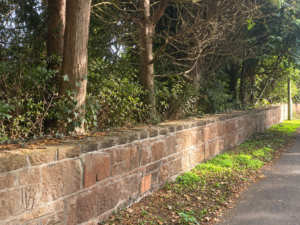
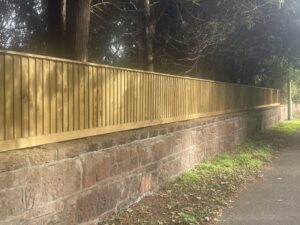
Case Study: Wall Top Feather Edge Fencing in Sefton
A sandstone wall gives a boundary character, but its height may leave the space behind it more open than the owner would like. For this project in Sefton, we fitted a 900 mm high feather edge fence along the top of an existing stone wall. The aim was to add screening while allowing the sandstone to remain a visible part of the finished boundary.
The wall runs alongside a path, with mature trees behind it. That setting called for a fence that looked tidy from the path and sat comfortably against the greenery. Feather edge boards offered a straightforward solution: their overlapping layout creates a solid screen, while the natural timber suits the stonework below.
Working with the Existing Wall
A wall top fence needs to follow the line of the wall beneath it. We planned the position of the fencing along the sandstone boundary, paying attention to the changing perspective as the wall runs into the distance. Keeping the boards and top edge aligned was key to making the installation look like one continuous addition rather than a series of separate sections.
We also wanted the fence to complement the wall, not hide it. At 900 mm high, the new timber adds a useful level of screening above the stonework while leaving plenty of sandstone on show. From the path, the two materials remain distinct: the established stone forms the base, and the new fencing gives the boundary extra height.
Fitting the Feather Edge Boards
We installed the feather edge boards along the wall top to form a close, consistent screen. Each board overlaps the next, helping to reduce gaps when viewed from the path. We checked the spacing and alignment as the fence took shape so the finished run would look even across its full length.
The timber’s warm colour contrasts gently with the darker trees behind it. It also brings out the varied tones in the sandstone. Rather than making the boundary feel heavy, the boards create a clear line above the wall and give it a more complete appearance.
To finish the installation, we added a neat timber cap along the top. This small detail makes a visible difference on a long fence: it gives the boards a defined upper edge and ties the sections together when seen from either end of the path.
The Finished Boundary
The completed wall top fence gives this Sefton property more screening while retaining the original sandstone wall as a feature. Its 900 mm height adds presence to the boundary, and the overlapping feather edge boards create a more enclosed feel behind it.
From the path, the result is a clean run of timber above the stonework, finished with a straight, tidy cap. The fence works with the trees and wall already on site, making the boundary look considered and complete. It is a good example of how adding fencing to an existing wall can improve privacy and appearance without replacing the character that was there to begin with.
A garden fence is easy to overlook when it is straight, secure and doing its job properly. It only becomes the centre of attention when a panel disappears during a storm, a post begins leaning towards the neighbour’s garden or the dog discovers a newly created escape route.
Merseyside Fencing provides garden fencing installation and repair services throughout Sefton. We help homeowners improve privacy, strengthen their boundaries and create safer outdoor spaces with fencing chosen for how each garden is actually used.
Sefton contains a wide variety of homes and outdoor spaces, from traditional terraces in Bootle and Litherland to family homes in Crosby, Maghull and Aintree and larger gardens around Formby, Hightown and Southport. Consequently, a fencing arrangement that works perfectly at one property might be completely unsuitable at another.
We assess the boundary, access, exposure and purpose of the fence before recommending an appropriate solution.
Start With the Problem, Not the Panel
It is tempting to choose fencing from a photograph, but appearance is only one part of the decision. A successful installation begins by identifying what the new fence needs to accomplish.
You may require fencing to:
- Create greater privacy from surrounding properties
- Enclose a garden safely for children or pets
- Replace a boundary damaged by wind or decay
- Separate a patio from a utility or storage area
- Improve security around a side passage
- Screen bins, sheds or garden equipment
- Give a neglected garden a cleaner appearance
- Support climbing plants
- Close gaps along an awkward boundary
- Complement new paving, decking or landscaping
Once the priorities are clear, decisions about height, construction, posts and finishing become considerably easier.
Privacy Without Making the Garden Feel Smaller
Many homes across Sefton have closely positioned neighbouring properties. Privacy therefore matters, particularly around patios, conservatories, outdoor dining areas and rear-facing windows.
A tall, solid fence offers effective screening, but it can also cast shadows or make a compact garden feel enclosed. The best solution may involve combining different heights or styles rather than installing one imposing boundary everywhere.
For example, a garden might use solid fencing along the main boundary, decorative screening around a seating area and trellis where additional height is wanted without blocking all the daylight.
When planning privacy fencing, consider:
- The direction of morning and afternoon sunlight
- Which sections of the garden are overlooked
- Whether plants will grow alongside the boundary
- How the fence will appear from inside the house
- The effect of additional height on neighbouring gardens
- Local planning restrictions
- Who is responsible for the boundary
This approach produces a more balanced result than simply choosing the tallest available panel.
Designing Fencing for Windy and Exposed Areas
Wind does not affect every Sefton garden equally. Properties closer to the coast, including homes around Formby, Hightown and Southport, may experience stronger winds than enclosed gardens in more built-up areas. Buildings, alleyways and gaps between houses can also funnel gusts towards particular sections of fencing.
A solid fence acts like a sail. If the posts, foundations or fixings are inadequate, repeated movement can gradually loosen the entire structure.
Options for exposed positions may include:
- Stronger posts and appropriately prepared foundations
- Shorter spans between supporting posts
- Robust closeboard construction
- Hit-and-miss boards that allow some airflow
- Slatted sections in suitable locations
- Concrete posts and gravel boards
- Careful reinforcement of corners
- Additional attention to changes in direction
The correct solution depends on the individual site. An open-style fence may reduce wind pressure, but it will provide less privacy. We help customers weigh those competing requirements.
Making Gardens Safer for Children and Pets
A family garden needs more than an attractive boundary. It must also be dependable.
For households with young children, fencing should not contain loose boards, projecting nails or openings that allow access to roads, driveways or neighbouring properties. Gates require reliable catches and should be installed so that they do not drag across the ground.
Pet owners have different concerns depending on the animal. A small dog may squeeze beneath a panel, while a larger dog may push against weak boards. Some dogs are determined diggers; others are surprisingly talented jumpers.
Useful safety features can include:
- Solid boards without pet-sized gaps
- Gravel boards along the bottom edge
- Securely installed garden gates
- Strong gate latches
- An appropriate fence height
- Reinforcement around known escape points
- Smoothly finished timber near play areas
- Regular checks following severe weather
We can discuss how the garden is used and identify obvious weak points before work starts.
Should You Repair or Replace the Fence?
A damaged fence does not automatically require complete replacement. One failed post can cause several otherwise usable panels to lean. Replacing that post may restore the fence at a much lower cost than rebuilding the entire boundary.
Repair is often sensible when:
- Damage is limited to one or two sections
- Most of the posts remain firm
- The panels are generally in reasonable condition
- A gate only requires adjustment or new fittings
- Individual boards or rails can be replaced
- The fence is relatively recent
Replacement may offer better value when:
- Several posts have rotted at ground level
- Panels are brittle or breaking apart
- The fence has already been patched repeatedly
- Large sections move during windy weather
- The existing design no longer provides enough privacy
- The gate and adjoining structure have both failed
- Repair costs are approaching the cost of replacement
We explain the condition of the existing fence so customers can decide whether a targeted repair or planned replacement is the most economical option.
What Happens Before Installation?
Good fencing work begins before the first new post is installed. Measurements must be checked, the correct boundary identified and practical access considered.
Preparation may involve:
- Measuring the complete fence line
- Checking changes in ground level
- Identifying existing posts and concrete
- Confirming responsibility for the boundary
- Protecting nearby paving or planting
- Planning the removal of old fencing
- Agreeing the position of new gates
- Checking the gate’s opening direction
- Looking for visible services and obstructions
- Arranging materials and waste removal
Customers should remove delicate ornaments and provide reasonable access where possible. Established shrubs may need tying back, although substantial planting can sometimes affect where the new fence can be positioned.
Fencing on Slopes and Uneven Ground
Gardens are rarely perfectly level. Installing standard panels without accounting for a slope can leave large gaps underneath or produce an untidy top line.
Fencing across sloping ground can be stepped in sections or adapted more gradually, depending on the construction method. Closeboard fencing can be especially useful where individual boards need to follow changing ground levels.
The best method depends on:
- The steepness of the slope
- Panel or board dimensions
- Required privacy at ground level
- Drainage and soil retention
- Whether gravel boards are being installed
- The preferred appearance along the top
Careful planning is particularly important where children or pets must not be able to get beneath the fence.
Looking After Timber Garden Fencing
Timber is a natural material and will gradually change colour outdoors. Correct treatment, suitable drainage and occasional maintenance can extend its useful life.
Straightforward maintenance includes:
- Keeping wet soil and leaves away from timber panels
- Cutting back plants that trap moisture
- Checking posts following severe weather
- Using a suitable exterior timber treatment
- Replacing loose fixings before movement worsens
- Cleaning algae using an appropriate gentle method
- Checking that gates remain properly aligned
- Preventing constant contact with garden sprinklers
- Inspecting the bottoms of boards for deterioration
Painting or staining should only be carried out when the timber is suitably dry. Any new product should also be compatible with the treatment already applied to the wood.
Garden Gates That Work Properly
A badly fitted gate quickly becomes frustrating. It may scrape against paving, refuse to latch or gradually drop under its own weight.
A gate must be supported by strong posts, correctly braced and fitted with hardware appropriate for its size. Access should also be considered: a narrow decorative gate might look attractive but become impractical when moving wheelie bins, bicycles or garden machinery.
Before selecting a gate, consider:
- The width required for everyday access
- Whether it should open inward or outward
- The preferred level of privacy
- The position of hinges and catches
- Access for bins and bicycles
- Security from the street
- Safety for children and pets
- Whether its design should match the fence
Garden Fencing Throughout Sefton
Merseyside Fencing serves homes across the Sefton area, including:
- Bootle
- Crosby
- Waterloo
- Formby
- Maghull
- Aintree
- Litherland
- Netherton
- Thornton
- Hightown
- Seaforth
- Southport
Different locations present different challenges. A terraced home in Bootle may have restricted access through the property, making waste removal and material delivery especially important. A larger Formby or Southport garden may require a long, exposed fence run with consistent levels and substantial supporting posts.
We adapt our recommendations to the property rather than forcing every customer into the same fencing package.
Request a Garden Fencing Quote in Sefton
Merseyside Fencing installs, replaces and repairs garden fencing throughout Sefton. Whether you have one troublesome post, a garden gate that will not close or an entire boundary ready for renewal, we can assess the project and explain the appropriate options.
When requesting a quotation, it is helpful to provide:
- Your Sefton postcode
- The approximate boundary length
- Your preferred fence height
- Photographs of the existing boundary
- Details of any damaged posts
- Garden gate requirements
- Access restrictions
- Your preferred level of privacy
Contact Merseyside Fencing to discuss your garden and arrange a quotation. A carefully planned fence should do more than divide two properties—it should make your outdoor space safer, more private and easier to enjoy.